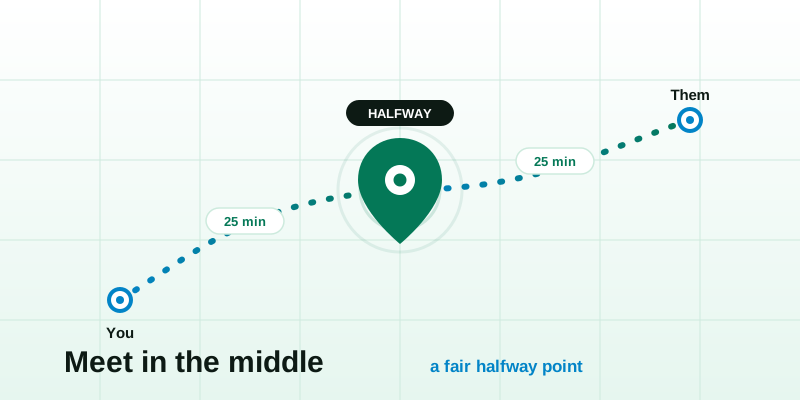
Two people, two different parts of town (or two different cities), and one question that has launched a thousand group chats: where do we actually meet? "Meeting in the middle" sounds simple, but the obvious answer — pick the point exactly between us — is usually the wrong one. This guide explains why a straight-line midpoint can be unfair, how to find a halfway point that respects everyone's travel time, how to pick a real venue near that point, and how to send one shared pin that everyone can open and navigate to in a single tap.
Why the "exact middle" is rarely the fair middle
The instinct is to draw a line between two locations and stop at the centre. It feels mathematically fair. But the geographic midpoint and the fair meeting point are two different things, because people don't travel in straight lines and they don't all travel at the same speed.
Here's where the straight-line midpoint quietly misleads you:
- Roads aren't straight. The point halfway "as the crow flies" might sit on the far side of a river, a motorway with no junction, a rail line, or a hill with no through-road. Your map says 6 km; your car says 25 minutes of detours.
- Traffic isn't symmetrical. One of you might have a clear ring road while the other crawls through the city centre. Equal distance can still mean wildly unequal time.
- Transport modes differ. If one person drives and the other takes a train or cycles, "halfway" by distance hands all the inconvenience to the slower mode.
- There may be nothing there. The true midpoint is often a random residential street or an industrial estate — geometrically perfect, socially useless. Nobody wants to "meet" at a roundabout.
So the goal isn't the centre of a line. It's the place that makes the two journeys feel roughly equal and has somewhere worth going.
The two ways to define "halfway"
Before you pick a spot, decide which kind of fairness you're optimising for. They lead to different answers.
| Definition | What it balances | Best when |
|---|---|---|
| Distance midpoint | Equal kilometres each way | Both people travel the same way (both driving, both on the same line) over open, similar roads |
| Time midpoint | Equal minutes each way | Different speeds, traffic, or transport modes — the most common real-world case |
| Effort midpoint | Equal hassle (parking, changes, cost) | One person has a far harder trip — e.g. a parent with a car seat vs. someone on foot |
For most friend, family, and dating meetups, time is the fair currency, not distance. "We each drove 25 minutes" feels fair. "We each drove 12 km" doesn't, if one of those 12 km took three times as long.
How to find a fair halfway point, step by step
You don't need a special algorithm to do this well. A few minutes with a map gets you a genuinely fair answer:
- Drop both starting points. Put a pin on where each person is leaving from. Seeing them on a map is more honest than picturing it in your head.
- Find the rough geographic middle. This is your starting guess, not your answer. Look at the area around it, not the exact pixel.
- Check the travel time both ways. Pull up directions from each start point to that middle area. If one journey is 15 minutes and the other is 35, the middle is in the wrong place.
- Slide the point toward the slower traveller. Nudge the meeting area along the route of whoever has the longer or harder trip until the two times even out. You're hunting for "we both arrive in about the same time," not "the dot is dead centre."
- Look for a cluster of options nearby. The best fair point is one with a few cafes, a station, or a high street within a couple of minutes — so you have a real venue, not a kerb.
- Confirm and drop the final pin. Once the times balance and there's somewhere to go, set that exact spot. That single pin becomes the thing you share — more on that below.
If you want to skip the back-and-forth of pinning, our meeting point tool lets you search an address or tap directly on the map to set the agreed spot, then hands you a ready-to-send link. Use the rough-middle method above to decide where, then use the tool to lock and share the exact pin.
Picking the actual venue — not just a point on a map
A fair coordinate is half the job. A point between two suburbs might be a car park; what people actually want is a place to sit, talk, eat, or hand something over. Once you've found the fair area, choose the venue with these in mind:
- Pick a landmark, not a coordinate. "The cafe on the corner of X" is easier to find and confirm than raw latitude and longitude. People relax when the destination has a name.
- Match the venue to the occasion. A first date wants somewhere public, easy to leave, and easy to find. A family handover wants parking. A hiking rendezvous wants a recognisable trailhead.
- Check parking and transit honestly. The fairest point is unfair again if one person circles for parking for ten minutes. Factor the "last 100 metres" into your time estimate.
- Have a fallback. If the chosen cafe is full or closed, a second option nearby saves another round of messages. Agreeing on a backup is a five-second insurance policy.
A good test: would a stranger be able to find this place from the name alone? If yes, your meeting point is solid.
Send one pin everyone can open
This is where most meetups still go wrong. Someone types a vague description, someone else misreads it, and two people end up at two different branches of the same coffee chain a kilometre apart. The fix is to stop describing the place and start sending the place — one pin, one tap, directions for everyone.
A single shared pin beats a paragraph of directions for a few reasons:
- No ambiguity. A pin is exact coordinates. There's no "which Main Street?" or "the one near the station, not the other one."
- It opens in their own maps. Tap the link and it drops straight into whatever map app they use, with navigation ready to go.
- It works for more than two. Coordinating three or four people? Everyone gets the identical pin, so everyone aims at the same dot.
- It's confirmable. The person sending it can see exactly what they're sending, so "is this the right place?" gets answered before anyone leaves home.
With the meeting point tool you set the agreed spot, then copy or share a link that opens the exact location in the recipient's maps app. No account needed on either end. It's a static "meet me here" pin — the right tool when everyone just needs to find one fixed place.
When to share live instead of a fixed pin
A fixed pin is perfect for the destination. But sometimes the destination isn't the hard part — the question is "where are you right now, and how close?" That's a different tool.
- Sending the destination? Use a static pin. Set the venue with the meeting point tool and send it once. It never moves, so there's nothing running afterward to switch off.
- The other person wants to track your approach? Share your movement with live location, and they'll watch your dot travel toward the spot on the view live location page. Set it to expire when you arrive.
- You just need to say "I'm here now"? A one-off snapshot from share my location answers it without broadcasting your whole journey.
Reach for the lightest option that fits. Most meetups need a fixed pin for the venue, and at most a short, expiring live share for the final few minutes of "I'm two streets away." For more on doing that part safely, see how to share your live location and is live location sharing safe.
A quick recap
Meeting in the middle well comes down to four moves: balance time, not just distance; nudge the point toward whoever has the harder trip; choose a real, nameable venue with a fallback; and send one shared pin instead of a paragraph of directions. Do that and "where should we meet?" stops being a negotiation and becomes a single tap.
Ready to coordinate your next meetup? Find the fair area with the method above, then open the meeting point tool to drop the exact spot and send everyone a pin they can open and navigate to instantly. If someone wants to follow your approach for the last stretch, hand them a short, expiring live location link and let them watch you arrive on the map. The fairest meeting point is the one everyone can actually find — so make finding it the easy part.